
Table of Contents
Key Takeaways
- AI recruitment can improve speed, consistency and candidate discovery.
- Employers remain responsible for every hiring decision supported by technology.
- Historical data can influence how algorithms rank and filter candidates.
- Human review brings context, fairness and informed professional judgement.
- Candidate data requires lawful, secure and transparent processing.
- Clear explanations help applicants understand how AI supports recruitment.
- Supplier checks strengthen accountability, security and long-term system performance.
- Regular monitoring helps employers improve fairness, accessibility and recruitment quality.
AI Recruitment Brings Opportunity Alongside Employer Risk
AI recruitment tools can help UK employers manage applications, identify relevant skills and communicate with candidates more efficiently. Yet AI recruitment risks UK organisations should understand can emerge when automated systems influence important decisions under limited governance.
For a hiring manager reviewing dozens of applications, AI can organise candidate information and surface suitable profiles quickly. The technology can support a more consistent process, while human judgement brings context, experience and a fuller understanding of each candidate.
Around 70% of UK workers hold roles containing tasks that AI could potentially perform or enhance, according to a UK government assessment published in January 2026. This exposure represents the potential for AI to support or reshape workplace tasks. It serves as an indicator of possible change rather than a forecast of confirmed job loss.
AI Tools Support Several Recruitment Activities
Employers can use AI across different stages of the hiring journey:
- CV parsing: AI can organise details from CVs into structured fields, helping recruiters review skills, experience and qualifications more efficiently.
- Candidate matching: Matching systems can compare vacancy requirements with candidate profiles and highlight potentially relevant connections.
- Shortlisting support: Automated tools can arrange applications according to selected criteria, giving recruiters a clearer starting point for human review.
- Candidate assessment: AI-supported assessments can help employers review technical skills, written responses and role-related capabilities.
- Recruitment communication: Chatbots and automated messages can answer common questions, share updates and guide candidates through application steps.
Clear Governance Keeps Employers in Control
Automation can improve speed and consistency, while effective governance gives each recommendation the right level of human attention. Employers remain responsible for recruitment decisions, even when an external technology provider supplies the platform or algorithm.
Key areas for employer oversight include:
- Fair candidate treatment: Recruiters should review how tools rank, filter and present applicants.
- Data protection: Candidate information should receive appropriate handling, storage and access controls.
- Human judgement: Hiring professionals should examine evidence, consider individual circumstances and retain authority over final decisions.
- Candidate transparency: Applicants should receive clear information about how AI supports the recruitment process.
The following sections examine ten important risks, including algorithmic bias, data processing, accessibility, supplier accountability and automated decision-making. Each risk includes practical controls that can help UK employers build a more transparent, responsible and human-led recruitment process.
What Do AI Recruitment Risks Mean for UK Employers?
AI recruitment risks refer to areas that require careful management when technology influences hiring activity. For UK employers, the level of responsibility depends on how each tool supports candidate sourcing, assessment, ranking and communication.
AI can improve recruitment speed and consistency. Clear governance also keeps fairness, privacy, accessibility and human judgement at the centre of every hiring decision.
AI Recruitment Covers Several Hiring Activities:
AI can support employers throughout the recruitment journey. Each application requires suitable controls based on its purpose and influence.
- CV parsing: AI can organise CV details into structured fields, helping recruiters review experience, qualifications and career history efficiently.
- Skills extraction: The technology can identify technical abilities, transferable skills and role-related strengths from candidate information.
- Candidate matching: Matching tools can compare vacancy requirements with candidate profiles and highlight potentially relevant connections.
- Candidate ranking: AI can arrange profiles according to selected criteria, giving hiring teams a practical starting point for review.
- Automated assessments: Digital tools can support skills tests, written exercises and role-related evaluations through consistent assessment methods.
- Interview analysis: Selected systems can organise interview responses and identify information related to predefined role criteria.
- Recruitment chatbots: Chatbots can answer common questions, guide applicants through forms and share timely application updates.
- Job advert creation: Generative AI can help employers draft clear role descriptions, responsibilities and candidate requirements.
- Fraud detection: AI-supported monitoring can identify unusual account activity, repeated profile details and patterns requiring further review.
Risk Levels Depend on How Employers Use Technology:
The influence of an AI tool shapes the level of governance required. Administrative assistance carries a different level of impact from candidate ranking, shortlisting or application outcomes.
- Administrative support: Tools used for scheduling, formatting and communication usually support routine tasks while recruiters continue to manage the hiring process.
- Recommendation support: Candidate-matching and ranking tools influence which profiles receive early attention, making clear criteria and regular reviews important.
- Significant decisions: Systems that influence shortlisting or candidate progression require stronger safeguards, transparent processes and qualified human involvement.
- Meaningful human review: Recruiters should examine the evidence behind each recommendation, consider individual circumstances and retain authority over the outcome.
- Candidate transparency: Clear information helps applicants understand where AI supports the process and how they can update inaccurate profile details.
A human reviewer adds professional judgement, context and practical understanding. This contribution becomes especially valuable when a candidate follows a non-traditional career route or presents transferable experience through an unfamiliar job title.
Employer Accountability Continues Across Third-Party Tools:
A recruitment technology supplier provides the system, while the employer remains responsible for how the tool influences hiring activity. Clear responsibilities help both parties manage candidate information and recruitment decisions consistently.
- Fair candidate treatment: Employers should review how the system evaluates different profiles and how selection criteria affect candidate groups.
- Privacy management: Candidate information should receive lawful, secure and purpose-led handling throughout the recruitment process.
- Accessible recruitment: Employers should provide suitable adjustments and equivalent assessment options for candidates with different access requirements.
- Decision ownership: Hiring managers should retain control over shortlisting, interviews, employment checks and final recruitment decisions.
- Supplier assessment: Employers should review the provider’s data practices, security controls, model documentation and performance-monitoring process.
- Documented governance: Clear records can show who reviewed an AI recommendation, which evidence informed the decision and how the final outcome developed.
AI-assisted recruitment works best when technology supports people rather than directing the entire process. This balance gives UK employers a stronger foundation for managing fairness, candidate trust and responsible decision-making across the ten key risks covered next.
Review Your AI Recruitment Process
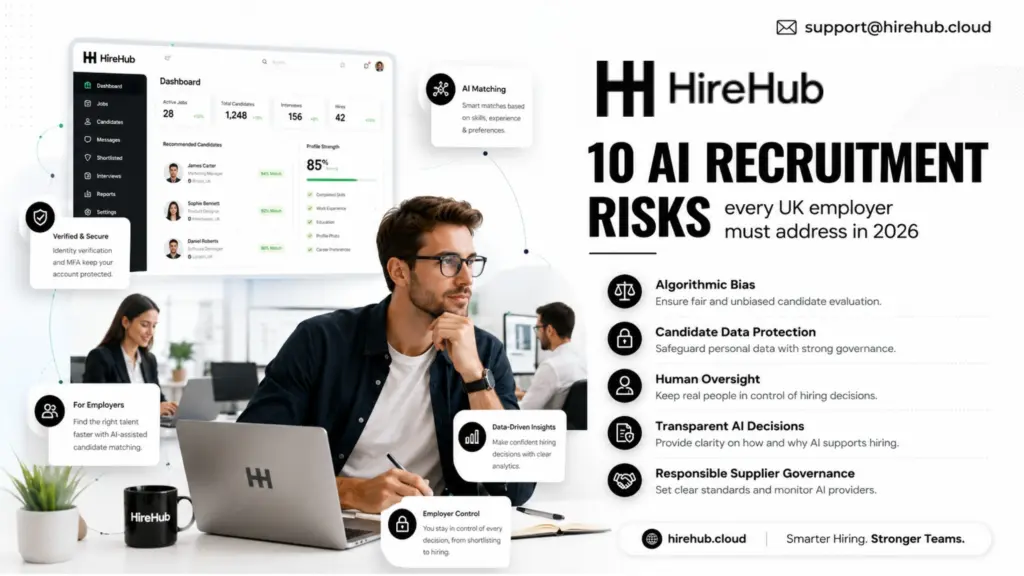
10 AI Recruitment Risks Every UK Employer Must Address:
AI tools can help employers organise applications, identify relevant talent and support quicker recruitment decisions. These benefits become stronger when each system receives clear human oversight, fair testing and careful data management.
The following AI recruitment risks UK employers should address show where stronger controls can protect candidates, recruitment teams and business reputation. Each risk also includes practical actions that support a fairer and more transparent hiring process.

1. Algorithmic Bias Can Reinforce Recruitment Inequality:
AI systems learn from information, patterns and criteria selected during their development. When historic recruitment data reflects earlier preferences, an automated tool may carry those patterns into future candidate rankings.
UK government guidance explains that recruitment AI can perform differently across candidate groups. Historic data can carry learnt bias, while tools analysing face, speech or voice information may show different accuracy levels for people with protected characteristics.
Common sources of algorithmic bias include:
- Historic recruitment data: Previous hiring decisions may reflect established preferences for certain education routes, career histories or working patterns.
- Under-representative datasets: A system trained on a narrow candidate group may produce less reliable results for people with different backgrounds or experiences.
- Proxy variables: Seemingly neutral information can reflect personal or social circumstances. A postcode may indicate income patterns, travel access or local opportunity levels.
- Unequal error rates: A tool may recognise information more accurately for one group than another, creating different outcomes from the same process.
- Protected characteristics: Age, disability, race, religion or belief, sex and other protected characteristics require careful consideration throughout recruitment.
The Equality Act 2010 protects job applicants from discrimination. This protection applies across advertising, screening, interviews and selection.
Practical examples include:
- Postcode-based ranking: A location filter may give greater visibility to candidates from areas associated with previous successful hires.
- Employment-gap scoring: A long career break may receive a lower score, even when the candidate used that period for caring responsibilities, study or recovery.
- School-history weighting: A model may favour educational institutions that appeared frequently within its earlier training data.
- Language scoring: Writing or speech analysis may respond differently to regional accents, international English or varied communication styles.
- Fixed working-pattern filters: Strict availability rules may reduce visibility for candidates managing caring responsibilities.
Employer actions include:
- Test outcomes across candidate groups: Compare how the tool performs for people with different backgrounds, career routes and accessibility needs.
- Review ranking variables: Confirm that each criterion connects directly with the vacancy and role requirements.
- Investigate unexplained differences: Examine patterns where one candidate group receives consistently different scores or outcomes.
- Maintain human review: Give trained recruiters the authority to assess context and adjust recommendations.
- Use evidence-led language: Replace absolute claims such as “bias-free” with clear descriptions of testing, monitoring and human control.
2. Automated Decisions Can Remove Human Context:
A recruitment score gives a structured view of selected information. Human reviewers add professional judgement, career context and a fuller understanding of candidate potential.
The Data (Use and Access) Act 2025 describes a solely automated decision as one involving an absence of meaningful human involvement. Safeguards for significant automated decisions include information for the individual, an opportunity to make representations and access to human intervention.
Human context can receive less attention through:
- Automatic approval: A recruiter may accept a system recommendation quickly, especially during high-volume recruitment.
- Automation bias: A match score may appear more reliable because technology produced it.
- Limited independent judgement: Reviewers may focus on the final ranking rather than the evidence behind it.
- Heavy reliance on scores: A percentage can become the main decision point, even when several candidates show comparable potential.
- Transferable skills receiving less weight: Skills developed in another sector may sit outside the model’s familiar job-title patterns.
- Limited challenge routes: Candidates may need a clear process for requesting an explanation or human review.
Practical example:
An AI tool places a candidate below the shortlist level because their previous job titles differ from the vacancy. Their experience still includes team leadership, client communication and project delivery. A recruiter who reviews those capabilities may recognise a strong match that the title-based score only partly reflects.
Employer actions include:
- Create a documented review process: Set out how recruiters examine the evidence behind recommendations.
- Define reviewer authority: Give hiring professionals clear permission to adjust or override automated rankings.
- Record important decisions: Capture the reasoning behind shortlist and progression decisions.
- Review transferable experience: Consider skills, achievements and responsibilities alongside previous job titles.
- Provide candidate review routes: Explain how applicants can correct information and request human consideration.
3. Candidate Data Can Face Unlawful or Excessive Processing:
Recruitment platforms often process CVs, employment records, qualifications, location preferences, assessment results and communication history. Clear data governance helps employers use this information for a defined recruitment purpose.
The ICO advises employers to explain how an AI tool processes candidate information, why the tool uses it and how its outputs may affect people. Recruiters and technology providers also need clearly recorded controller and processor responsibilities.
The ICO made 296 recommendations and issued 42 advisory notes after auditing providers of AI-powered recruitment tools. The areas covered included privacy management, data minimisation, transparency, risk management, fairness, security and human review.
Important data-protection areas include:
- UK GDPR principles: Candidate information requires lawful, fair and transparent processing.
- Data Protection Act 2018: This legislation supports the UK framework for personal-data processing and individual rights.
- Data minimisation: Employers should collect information that directly supports recruitment activity.
- Purpose limitation: Candidate data should serve clearly defined uses communicated to the applicant.
- Lawful basis: Each processing activity requires an appropriate legal basis.
- Retention periods: Candidate information should remain available for a justified and documented period.
- Third-party access: Employers should understand which providers and subprocessors receive candidate information.
- Model training: Recruitment teams should establish whether candidate information contributes to AI development or improvement.
- International transfers: Data movement across countries requires suitable legal and contractual arrangements.
Key employer questions include:
- Which candidate data does the tool collect?: Create a complete list of profile fields, documents, assessment results and technical information.
- Why does each data field support recruitment?: Connect every data point with a clear recruitment purpose.
- Does candidate information train AI models?: Ask the provider how submitted information contributes to system development.
- Which subprocessors receive the information?: Identify hosting, verification, analytics and communication providers.
- How long does the provider retain data?: Review active-account, closed-account and backup retention periods.
- Can candidates correct or delete information?: Provide accessible routes for data rights and profile updates.
4. Black-Box Scoring Can Weaken Candidate Transparency:
Black-box scoring describes a result whose reasoning remains unclear to the employer or candidate. A match score may appear simple on screen while drawing on several hidden factors and weightings.
Transparency concerns may develop through:
- Hidden weighting: Employers may see the final score while receiving limited detail about how each criterion contributed.
- Unclear match logic: Candidates may understand the job requirements yet remain unsure why their profile received a particular ranking.
- Limited supplier explanations: A provider may describe its technology broadly while offering little detail about practical decision factors.
- Unexplained outcomes: Candidates may receive a general update that gives limited insight into the assessment.
- Reduced candidate confidence: Clear communication supports trust throughout the application journey.
- Difficult error identification: Employers need enough detail to recognise inaccurate skills, missing data or unsuitable criteria.
Employers should request explanations covering:
- Matching criteria: Show which skills, experience, salary, location and availability factors contribute to the result.
- Fixed screening rules: Explain which requirements automatically influence candidate progression.
- Weighting: Clarify which factors receive greater influence and why.
- Missing information: Describe how incomplete fields affect the score.
- Score limitations: Present the result as a relevance indicator rather than a prediction of future performance.
- Candidate correction routes: Let applicants update skills, experience and preferences.
- Model updates: Ask suppliers to communicate changes that could affect rankings or recommendations.
5. AI Can Overlook Qualified and Non-Traditional Candidates:
Recruitment algorithms often work best with clear patterns. Candidates with varied career routes may present valuable experience through titles, sectors or formats that differ from the model’s familiar examples.
Government responsible AI guidance notes that screening tools trained on historic data may inherit earlier recruitment preferences or use proxy indicators with limited relevance to the position. It also highlights employment gaps as an area requiring careful assessment.
Candidate groups requiring broader assessment include:
- Career changers: Their previous job title may differ from the vacancy while their communication, leadership or technical skills remain highly relevant.
- Volunteers: Community and charitable work can develop planning, teamwork and service skills.
- Former military personnel: Military roles often include operations, logistics, training and leadership experience expressed through specialist terminology.
- International professionals: Qualifications and job titles may follow different naming systems across countries.
- Portfolio professionals: Freelance, contract and project work may appear across several shorter roles.
- Candidates with career gaps: Caring, education, health and personal commitments can shape employment timelines.
- Candidates with unusual job titles: Similar responsibilities can sit beneath very different titles across sectors.
- Candidates with transferable skills: Capabilities developed in one setting can support performance in another.
Employer actions include:
- Test varied CV formats: Include career changers, returners, contractors and international professionals during system testing.
- Review lower-ranked profiles: Carry out regular quality checks across candidates who received less visibility.
- Use skills-led search: Prioritise capabilities and achievements alongside titles.
- Broaden job-title matching: Include related role names and sector-specific variations.
- Provide profile correction: Give candidates a clear way to update extracted experience and skills.
6. Automated Assessments Can Create Accessibility Barriers:
Digital assessments should give every candidate a fair opportunity to demonstrate role-relevant ability. Accessible design helps employers reach a broader talent pool and support reasonable adjustments.
DSIT guidance identifies digital exclusion across recruitment technology and highlights age, disability, socioeconomic circumstances and access to technology as relevant considerations.
Accessibility considerations include:
- Timed assessments: Some candidates benefit from additional time or a flexible completion window.
- Video interview analysis: Camera quality, lighting, movement and eye contact may influence automated interpretation.
- Voice analysis: Regional accents, international speech patterns and speech conditions can affect transcription or scoring.
- Facial analysis: Expression and movement can vary across disability, culture and personal communication style.
- Screen-reader compatibility: Forms, instructions and assessment tools should work with assistive technology.
- Neurodivergence: Eye contact, response timing and communication style may differ while job capability remains strong.
- Speech conditions: Alternative response formats can support clearer and fairer assessment.
- Visual or hearing impairments: Captions, transcripts, audio descriptions and keyboard access can improve participation.
- Reasonable adjustments: Candidates need a clear and respectful route for requesting support.
Employer actions include:
- Offer alternative assessment formats: Provide written, verbal or live human-led options where appropriate.
- Use accessible interfaces: Test forms and assessments with keyboard navigation and assistive technology.
- Share adjustment information early: Explain available support before the candidate begins the assessment.
- Provide human assistance: Give candidates a direct contact for technical or accessibility support.
- Apply equivalent standards: Assess the same role-related capability through a suitable format for each candidate.
7. Supplier Contracts Can Create False Confidence:
A supplier may provide the technology, documentation and support. The employer still decides how the system fits within recruitment and how its outputs influence candidates.
The ICO advises recruiters and AI providers to identify controller and processor roles accurately and record those responsibilities within contracts, privacy information and impact assessments.
Supplier governance should cover:
- Employer responsibilities: Define how recruiters review outputs, communicate with candidates and complete final selection.
- Provider responsibilities: Clarify hosting, system development, maintenance, security and data processing.
- Controller and processor roles: Establish which organisation determines the purpose and method of each processing activity.
- Marketing claims: Request evidence supporting statements about accuracy, fairness, security and compliance.
- Documentation quality: Review model information, testing reports, data flows and system limitations.
- Audit access: Include practical rights to request evidence and assess supplier performance.
- Model changes: Set a process for receiving notice when updates influence scoring or data use.
Supplier due-diligence questions include:
- Which data trained the system?: Ask about sources, quality, relevance and geographic coverage.
- Which candidate groups supported testing?: Review whether testing reflects the organisation’s expected applicants.
- How does the supplier monitor bias?: Ask for methods, review frequency and outcome measures.
- Who receives candidate data?: Request a complete list of subprocessors and processing locations.
- How does deletion work?: Confirm active systems, archives, backups and model-training datasets.
- Which audit rights does the employer receive?: Include access to reports, incidents and material changes.
- How do model updates affect performance?: Ask for change records and renewed testing evidence.
8. Security Failures Can Expose Sensitive Recruitment Data:
Recruitment systems hold detailed personal and commercial information. Strong security controls protect candidates, employer teams and the continuity of the hiring process.
Sensitive recruitment information includes:
- CV data: Employment history, education, contact details and professional achievements.
- Identity information: Verification records and supporting documents.
- Candidate messages: Interview details, availability and personal communication.
- Interview records: Notes, recordings, transcripts and assessment results.
- Employer dashboards: Vacancy data, shortlists, internal notes and user permissions.
- Payment details: Subscription, listing and verification transactions.
- Third-party integrations: Connected assessment, communication, identity and payment services.
Security concerns may develop through:
- Account takeover: Weak login controls can allow another person to access an employer or candidate account.
- Data leakage: Incorrect permissions or technical errors can make information visible to unintended users.
- Limited access controls: Broad internal permissions can give more employees access than their role requires.
- Insecure integrations: Connected tools can create additional routes into candidate and employer data.
- Prompt-based manipulation: Instructions placed within submitted content may attempt to influence an AI tool’s response.
- Extensive administrator access: Powerful account permissions require careful allocation and monitoring.
- Slow incident response: Clear procedures support swift action when unusual activity appears.
Employer actions include:
- Review authentication: Use multi-factor authentication and secure account-recovery processes.
- Confirm encryption: Ask how the provider protects information during transfer and storage.
- Limit access: Give each user permissions aligned with their recruitment responsibilities.
- Monitor activity: Review unusual logins, large data exports and permission changes.
- Assess backups: Confirm recovery processes and retention arrangements.
- Prepare incident procedures: Set clear reporting, investigation and communication responsibilities.
- Request supplier evidence: Review current security testing, policies and assurance documents.
9. Heavy Automation Can Weaken Recruiter Judgement:
Recruitment experience develops through CV review, candidate conversations, interviews and reflection on hiring outcomes. AI should support these skills while leaving professional judgement active.
Recruiter dependence may develop through:
- Automation bias: Recruiters may give greater weight to a system score than to their own review.
- Reduced skill practice: Heavy reliance on automated screening can limit regular use of sourcing and assessment skills.
- Narrow independent assessment: Teams may focus on recommended profiles and give less attention to the wider candidate pool.
- Confirmation bias: A high match score may shape how reviewers interpret later evidence.
- Dependence on rankings: Candidate order can influence attention before a recruiter reads the full profile.
- Reduced candidate context: Career motivation, potential and personal circumstances may receive less consideration.
Employer actions include:
- Train recruiters to question outputs: Help teams understand system purpose, criteria and limitations.
- Monitor override rates: Review how often recruiters change automated recommendations and why.
- Compare selected and lower-ranked candidates: Run regular quality checks across both groups.
- Use manual review samples: Assess a selection of applications through a separate human-led process.
- Measure hiring outcomes: Review candidate progression, retention, performance and experience alongside software activity.
- Keep interview skills active: Use structured human interviews to explore evidence, motivation and role fit.
10. Cross-Border Hiring Can Add Further Compliance Duties:
Online recruitment can connect a UK employer with candidates, technology providers and hosting services across several countries. A clear location map helps the organisation identify which rules and contractual controls may apply.
Relevant UK considerations include:
- UK GDPR: This framework governs personal-data processing involving UK candidates and organisations.
- Data Protection Act 2018: The Act supports data-protection rights and responsibilities within the UK.
- Data (Use and Access) Act 2025: The Act introduced updated provisions for automated processing and significant decisions.
- Equality Act 2010: Job applicants receive protection from workplace discrimination throughout recruitment.
- International transfers: Candidate information moving abroad requires suitable safeguards and documentation.
- Overseas providers: Hosting, assessment and AI services may process information from another jurisdiction.
- International candidates: Candidate location can influence privacy notices, transfer arrangements and recruitment requirements.
The European Commission classifies many AI systems used for recruitment as high-risk under the EU AI Act. Coverage for a UK employer depends on the organisation’s activities, deployment, users and affected markets.
Employer actions include:
- Map candidate locations: Record where applicants live and where recruitment activity takes place.
- Map employer operations: Identify offices, customers and hiring teams across the UK, EU and other markets.
- Map provider locations: Confirm where suppliers, subprocessors and hosting services operate.
- Map data-transfer routes: Follow candidate information from collection through storage, analysis and deletion.
- Identify applicable laws: Seek specialist guidance where multiple jurisdictions connect with the recruitment process.
- Clarify contractual responsibilities: Define privacy, security, audit, incident and deletion obligations for every provider.
A structured approach turns these ten risks into manageable work areas. Employers gain clearer oversight, candidates receive a more transparent experience and recruitment teams retain the human judgement that gives technology its practical value.
Which AI Hiring Risks Demand Immediate Attention?:
Every AI recruitment risk deserves clear ownership, yet several areas require earlier action because they directly influence candidate opportunities, personal information and significant hiring decisions.
For UK employers, the highest priorities usually involve discrimination, automated decision-making, privacy, accessibility and supplier governance. The ICO has placed automated recruitment decisions under regulatory focus, particularly around transparency, discrimination, candidate safeguards and meaningful human involvement.
The following matrix uses qualitative categories based on candidate impact, employer responsibility and the level of governance each area requires.

Discrimination and Automated Decisions Need Priority Review:
AI systems can influence which candidates receive visibility, progress to the next stage or enter an employer’s shortlist. These outcomes make fairness and meaningful human judgement central parts of responsible recruitment.
The ICO identifies limited training-data diversity, unsuitable data, historic discrimination and system-design choices as common sources of unfair AI outcomes. It also recommends testing systems across relevant groups and monitoring results throughout the AI lifecycle.
Employers should prioritise the following areas:
- Candidate-group outcomes: Compare shortlisting, ranking and progression patterns across relevant candidate groups to identify meaningful differences.
- Protected characteristics: Review whether system criteria or proxy variables influence people according to age, disability, race, sex or other protected characteristics.
- Significant decisions: Apply stronger safeguards when automated tools influence rejection, shortlisting or progression.
- Human review quality: Give trained recruiters enough information, time and authority to assess the system’s recommendation independently.
- Candidate safeguards: Provide clear routes for applicants to correct information, share relevant context and request human consideration.
- Decision records: Document how automated recommendations contributed to important hiring outcomes.
The ICO’s 2026 findings indicate that many employers using recruitment automation may rely on solely automated decisions with legal or similarly significant effects. The regulator also calls for stronger transparency, consistent human involvement and wider fairness monitoring.
Candidate Data and Accessibility Require Equal Attention:
Candidate privacy and accessibility deserve attention from the first stage of technology selection. AI recruitment tools may process CVs, assessments, interview responses, profile details and technical information connected with an application.
Responsible data use begins with a clear purpose for every piece of information.
- Data minimisation: Collect the personal information required for a defined recruitment activity.
- Clear lawful basis: Record the legal basis supporting each type of candidate-data processing.
- Purpose clarity: Explain why the system uses candidate information and how its outputs may influence recruitment.
- Retention controls: Set clear periods for active applications, talent pools, account records and provider-held information.
- Candidate rights: Give applicants practical routes to access, correct and manage their information.
- Accessible assessment formats: Offer suitable options for candidates using assistive technology or requiring reasonable adjustments.
- Early adjustment guidance: Tell candidates how to request support before completing an assessment or interview.
- Equivalent evaluation: Assess the same job-related capability through formats suited to different access needs.
The ICO advises employers to give candidates clear privacy information explaining how an AI tool uses personal data, why the tool supports recruitment and how applicants can challenge automated outcomes.
Privacy and accessibility also shape candidate confidence. A clear explanation, accessible process and responsive support route can help applicants participate with greater certainty.
Supplier Governance Supports Every Other Control:
A recruitment system may come from an external provider, yet the employer still decides how the tool enters the hiring process and how its outputs influence people.
Careful supplier selection supports fairness, privacy, security, transparency and candidate rights.
- Defined responsibilities: Record which organisation acts as controller or processor for each data activity.
- Data-flow visibility: Identify where candidate information enters, travels, receives analysis and reaches deletion.
- Bias-testing evidence: Ask the supplier for current testing methods, results and monitoring arrangements.
- Human-review features: Confirm that recruiters can understand, question and override system recommendations.
- Candidate explanations: Review the information available for explaining rankings, assessments and automated outcomes.
- Security assurance: Examine authentication, access controls, encryption, incident response and subprocessor arrangements.
- Audit rights: Include practical access to performance evidence, compliance records and material system changes.
- Change management: Require supplier updates when data use, scoring logic, model design or processing locations change.
The ICO recommends completing a Data Protection Impact Assessment during the procurement stage, documenting responsibilities in contracts and setting performance measures for accuracy and bias.
A polished sales demonstration shows how a platform looks. Strong supplier governance reveals how the system works, how it handles candidate information and how the employer retains control.
Labour-Market Evidence Adds Urgency to Responsible Recruitment:
Between 2022 and 2025, UK job adverts fell by 38% in occupations with high AI exposure, compared with 21% in lower-exposure occupations. The UK government assessment explains that these figures show an association between AI exposure and hiring patterns rather than confirmed causation. Interest rates, business cycles and sector-specific conditions may also contribute to the difference.
This evidence gives employers a practical reason to review AI-supported recruitment carefully. When job opportunities change, transparent assessment, fair candidate treatment and meaningful human judgement become even more important.
The first priority should therefore focus on decisions that shape candidate access. The next priority should protect candidate information and accessibility. Strong supplier governance then connects every control through one accountable recruitment process.
How Can UK Employers Reduce AI Recruitment Risk?
Reducing AI recruitment risks in the UK begins with clear ownership, reliable evidence and regular human review. Employers gain stronger control when they understand each tool, document its purpose and monitor how it influences candidates.
The following seven steps can help UK employers build a responsible AI recruitment process.
An AI System Inventory Creates Governance Visibility:
An AI system inventory gives employers one clear record of every automated tool used during recruitment. It helps HR, legal, data protection, security and procurement teams understand where technology influences the candidate journey.
The inventory should include:
- Tool name: Record the official product name, version and internal reference used by recruitment teams.
- Supplier: Identify the company providing, hosting or maintaining the system.
- Hiring stage: State whether the tool supports job advert creation, sourcing, CV review, matching, assessment, shortlisting, interviews or communication.
- Data processed: List the candidate information used by the system, including CV details, contact information, assessment responses and profile preferences.
- Decision influenced: Explain whether the tool organises information, recommends candidates, ranks profiles or supports progression decisions.
- Human reviewer: Name the role responsible for reviewing recommendations and applying professional judgement.
- Risk level: Classify the system according to its influence on candidates, the sensitivity of the data and the importance of the decision.
- Contract owner: Assign responsibility for supplier communication, renewals, audits and contractual updates.
A well-maintained inventory helps employers identify duplicated tools, unclear ownership and areas requiring closer review.
Impact Assessments Identify Risks Before Deployment:
Impact assessments help employers examine how an AI system may affect candidates, recruitment teams and personal information before live use.
UK government guidance presents impact assessments, bias audits and performance testing as useful AI assurance methods. The suitable assessment depends on the tool’s purpose, data use and influence on recruitment decisions.
Employers can consider:
- Data Protection Impact Assessment: Review how the system collects, analyses, shares, stores and deletes candidate information.
- Equality impact assessment: Examine how the tool may affect candidates with different protected characteristics or career backgrounds.
- Accessibility assessment: Test whether candidates using assistive technology or reasonable adjustments can participate fully.
- Security assessment: Review account access, encryption, integrations, incident response and supplier safeguards.
- Operational assessment: Examine how the tool fits within recruitment workflows, staff responsibilities and candidate communication.
Each assessment should produce practical actions, named owners and review dates. This turns governance into an active process rather than a file stored after procurement.
Human Oversight Needs Documented Authority:
Meaningful human oversight gives trained recruiters the information and authority required to evaluate AI recommendations independently.
A reviewer should understand the system’s purpose, examine the evidence behind its output and apply professional judgement to the candidate’s circumstances.
Employers should document:
- Who reviews recommendations: Assign qualified recruiters, hiring managers or assessment professionals to specific decision stages.
- Which evidence appears: Give reviewers access to the candidate profile, relevant criteria, extracted information and reasoning behind the recommendation.
- When manual review becomes mandatory: Define points where a person must assess the candidate before progression, shortlisting or rejection.
- Who can override the system: Grant clear authority to change rankings, restore candidate visibility or request further evidence.
- How decisions receive records: Capture the reviewer, evidence considered, reasoning and final outcome.
- How candidates request review: Provide a simple route for applicants to correct information, explain relevant circumstances or ask for human consideration.
Human oversight supports ethical AI recruitment by combining technological efficiency with experience, empathy and contextual judgement.
Bias Testing Needs Outcome-Based Evidence:
Fairness testing should examine how the system performs with real candidate profiles and recruitment outcomes. Supplier promises provide a starting point, while measured results give employers stronger evidence.
The ICO explains that fairness can change throughout the AI lifecycle. Training data, target variables, proxy information and deployment choices can all influence outcomes.
Employers should review:
- Accuracy: Measure how often extracted skills, candidate details and recommendations reflect the underlying information correctly.
- Incorrectly advanced profiles: Identify cases where a system gives strong visibility to candidates whose experience has limited alignment with the role.
- Missed suitable profiles: Review candidates whose relevant skills or transferable experience received limited recognition.
- Selection-rate differences: Compare progression patterns across relevant candidate groups.
- Missing-data effects: Test how incomplete CV fields, employment gaps or unavailable information affect rankings.
- Outcome disparities: Examine whether particular groups receive consistently different scores, shortlist rates or assessment results.
- Performance after model updates: Repeat testing after changes to data sources, matching criteria, scoring logic or system versions.
Testing should use realistic UK candidate profiles, including career changers, returners, international professionals and candidates requiring reasonable adjustments.
Candidate Notices Build Transparency:
Clear candidate information helps people understand how technology supports their application. It also gives them practical ways to check and correct the information used during recruitment.
The ICO advises organisations to explain how and why an AI tool processes personal information, the logic behind outputs and how candidates can challenge automated decisions.
Candidate notices should explain:
- Where AI supports recruitment: Identify the stages involving CV parsing, matching, assessment, ranking or communication.
- What data receives processing: List the information used by the system in clear language.
- How AI influences decisions: Explain whether the tool organises information, provides recommendations or contributes to progression.
- Whether human review takes place: Describe the role of recruiters and hiring managers within the process.
- How candidates correct errors: Provide a direct route for updating skills, work history, qualifications or personal details.
- How candidates raise concerns: Include contact information for privacy, accessibility and recruitment enquiries.
Short, accessible notices support candidate confidence. Detailed privacy information can then provide the full legal and technical explanation.
Supplier Assessment Must Continue After Purchase:
Supplier assessment begins during procurement and continues throughout the contract. AI systems can change through software updates, new data sources, revised scoring methods and additional subprocessors.
The UK government’s responsible AI recruitment guidance recommends assurance across procurement, deployment and live operation.
Employers should review:
- Model documentation: Request clear information about the system’s purpose, data sources, testing and limitations.
- Security: Examine authentication, access permissions, encryption, hosting and incident procedures.
- Bias testing: Ask for current evidence covering relevant candidate groups and recruitment uses.
- Accessibility: Confirm compatibility with assistive technology and alternative assessment options.
- Audit rights: Include contractual access to testing records, performance reports and compliance evidence.
- Incident reporting: Set clear timeframes and responsibilities for security, privacy or fairness concerns.
- Model changes: Require advance information about updates that may affect candidate outcomes.
- Deletion processes: Confirm how data leaves active systems, archives, backups and training datasets.
- Subprocessors: Maintain a current list of organisations that receive or handle candidate information.
Regular supplier meetings can connect contractual requirements with real recruitment performance.
Live Monitoring Protects Long-Term Performance:
An AI tool may perform well during testing and produce different results as vacancies, candidates and system features change. Live monitoring helps employers recognise these changes early and improve the recruitment process.
Employers should track:
- Candidate complaints: Review concerns about rankings, assessments, privacy, accessibility and communication.
- Recruiter overrides: Examine how often human reviewers adjust recommendations and the reasons behind those decisions.
- Outcome disparities: Compare candidate progression across roles, locations and relevant groups.
- System errors: Record inaccurate data extraction, unsuitable matches and technical interruptions.
- Accessibility concerns: Monitor adjustment requests, support enquiries and candidate feedback.
- Security incidents: Review unusual access, permission changes, data movement and supplier alerts.
- Supplier changes: Track updates to models, features, subprocessors, hosting and data practices.
Assign clear review periods, such as monthly operational checks and quarterly governance reviews. Senior leaders should receive concise reports showing key findings, actions and ownership.
A structured governance process helps UK employers use AI with greater clarity and confidence. System inventories create visibility, assessments identify priorities, human oversight protects judgement and continuous monitoring keeps recruitment decisions connected with fairness, transparency and candidate experience.
Keep Human Judgement at the Centre
HireHub’s Approach to Responsible AI-Assisted Recruitment:
Responsible recruitment technology should help people make clearer decisions while keeping employers and candidates actively involved. HireHub combines structured information, AI-assisted matching, human-led review, candidate verification and secure account access across its UK recruitment platform.
Nearly 23% of UK businesses reported using some form of AI technology in late September 2025, compared with 9% in September 2023. The figure covers AI use across wider business activity and shows how quickly technology has become part of everyday operations.
For employers reviewing AI recruitment risks in the UK, HireHub’s approach centres on clear matching criteria, employer-controlled decisions and defined trust signals.
AI Matching Supports Candidate Discovery:
HireHub uses structured vacancy and candidate information to identify potentially relevant connections. Matching considers practical details that help both sides begin with clearer expectations.
Matching may consider:
- Skills and experience: Candidate capabilities and employment history help show alignment with role requirements.
- Role requirements: Structured vacancy details help the system recognise essential responsibilities and employer expectations.
- Location: Postcode proximity, workplace location and remote preferences support practical candidate discovery.
- Availability: Working hours, contract preferences and start-date information help connect candidates with suitable opportunities.
- Pay expectations: Salary ranges and candidate expectations support clearer conversations from the beginning.
- Transferable skills: Cross-sector capabilities can highlight candidates whose experience carries value across different roles.
These factors support focused discovery while leaving room for employers to examine each person’s full profile, experience and potential.
Employers Retain Control Over Hiring Decisions:
HireHub’s AI-assisted matching highlights profiles that align with selected criteria. Employers continue to guide every important stage of the hiring journey.
Employer responsibilities include:
- Profile review: Hiring teams examine CVs, skills, experience, preferences and verification signals.
- Candidate conversations: Employers contact candidates and explore role alignment through direct communication.
- Interview decisions: Recruitment teams decide who progresses to an interview and which assessment methods suit the role.
- Employment checks: Employers complete right-to-work, reference, qualification, licence and sector-specific checks where relevant.
- Final selection: The employer evaluates the complete evidence and makes the hiring decision.
- Recruitment records: Clear records support accountability and help teams explain how decisions developed.
This approach keeps professional judgement at the centre while using technology to organise and prioritise information.
Candidate Profiles Support Correction and Visibility:
Accurate profiles help HireHub connect candidates with roles that reflect their experience, expectations and working preferences.
Candidates can strengthen profile quality through:
- Current CV information: Updated employment history and achievements give employers a clearer view of professional experience.
- Relevant skills: Technical, practical and transferable capabilities improve the quality of matching.
- Clear preferences: Location, salary, availability and contract choices help suitable opportunities appear.
- Complete profile fields: Structured information gives employers more context during search and review.
- Regular updates: Candidates can refresh their details as skills, availability and career goals develop.
- Visible match factors: HireHub provides insight into the criteria shaping candidate and vacancy recommendations.
Candidate-led updates support clearer profile visibility and give employers more reliable information for human review.
Verification and MFA Strengthen Platform Trust:
HireHub combines candidate verification with multi-factor authentication to support trust at profile and account level.
- Candidate identity verification: A visible verification status confirms that identity details have completed HireHub’s defined verification process through a specialist partner.
- Defined verification signals: Identity Verified, Profile Complete, Training Completed and Employer Rated badges communicate specific profile information.
- Verification scope: Identity verification confirms identity details. Qualifications, employment history, references, professional licences and right-to-work requirements remain separate employer-led checks.
- Employer interpretation: Verification provides useful context during matching and review while employers continue to assess role suitability.
- MFA-protected access: Employer accounts use multi-factor authentication through SMS, email or an authenticator application. This adds account protection for hiring activity, candidate information and payment details.
- Individual account security: Each company user completes MFA for their own login, supporting clear access responsibility across the recruitment team.
HireHub’s model brings together AI-assisted matching, employer-controlled decisions, transparent criteria, secure account access and defined verification signals. This combination helps technology support recruitment while people continue to guide conversations, assessments and hiring outcomes.
AI Recruitment Risk Checklist for UK Employers:
A practical checklist helps employers turn responsible AI recruitment principles into clear daily actions. Each control needs an owner, a review date and evidence showing how it supports fair, transparent and secure hiring.
UK government guidance also encourages organisations to use impact assessments, performance testing, bias audits and supplier evidence throughout procurement and deployment.
Governance Controls Need Clear Ownership:
Clear ownership helps every recruitment tool receive consistent review across HR, legal, data protection, procurement and security teams.
Employers can use the following checklist:
- AI inventory: Record every AI tool used for sourcing, CV parsing, matching, ranking, assessment, interview support and candidate communication.
- Defined purpose: Explain which recruitment task each system supports and how its output contributes to the hiring process.
- Lawful basis: Document the legal basis supporting each type of candidate-data processing.
- DPIA review: Assess whether the tool’s data use and influence on candidates require a Data Protection Impact Assessment.
- Equality review: Examine how criteria, datasets and outputs affect candidates with different protected characteristics and career backgrounds.
- Human oversight: Assign trained reviewers who can examine recommendations, apply context and change outcomes.
- Candidate notices: Provide clear information about where AI supports recruitment, which data it uses and how human review works.
- Supplier accountability: Record the provider’s responsibilities for data processing, system updates, testing, security and incident reporting.
- Internal ownership: Name the person responsible for the contract, system performance, candidate concerns and scheduled reviews.
- Review timetable: Set monthly operational checks and regular governance reviews based on the system’s purpose and influence.
These controls help employers connect policy with real recruitment activity. They also give teams a clear route for raising questions and recording improvements.
Candidate Protections Need Practical Access:
Candidate safeguards work best when applicants can understand and use them easily. Clear contact routes, accessible formats and prompt human support create a more confident recruitment experience.
Employers should provide:
- Profile correction route: Allow candidates to update skills, qualifications, employment history, availability and personal details used during matching.
- Human review request: Give applicants a clear way to ask a qualified recruiter to review an important AI-supported outcome.
- Accessible alternatives: Offer suitable assessment formats for candidates using assistive technology or requesting reasonable adjustments.
- Complaint process: Provide a named contact or support route for concerns involving data, accessibility, scoring or candidate treatment.
- Transparent explanations: Describe the factors influencing candidate matching, ranking or assessment in clear language.
- Data access route: Explain how candidates can request access to personal information held about them.
- Data correction rights: Give candidates practical steps for updating incomplete or inaccurate information.
- Privacy information: Explain which organisations receive candidate data, how long information remains stored and how it supports recruitment.
- Adjustment guidance: Share accessibility support before assessments, interviews or timed recruitment activities begin.
- Progress updates: Keep candidates informed when human review, data correction or complaint assessment takes place.
These protections support candidate participation and help recruitment teams identify information that requires further context.
Ongoing Monitoring Needs Evidence:
AI recruitment systems can develop through supplier updates, changing candidate groups, new vacancy types and revised employer criteria. Regular monitoring helps employers understand how each tool performs during real recruitment activity.
Monitoring should include:
- Bias testing: Compare ranking, shortlisting and progression patterns across relevant candidate groups.
- Accuracy reviews: Check whether extracted skills, employment details and matching criteria reflect candidate information correctly.
- Override monitoring: Record when recruiters change an AI recommendation and capture the reason for the adjustment.
- Complaint review: Assess candidate concerns for recurring themes involving transparency, accessibility, privacy or scoring.
- Security checks: Review account permissions, authentication, unusual access, data exports and supplier alerts.
- Model-change review: Examine supplier updates that affect data sources, scoring criteria, system logic or candidate outcomes.
- Accessibility monitoring: Track adjustment requests, technical support enquiries and feedback about digital assessments.
- Performance records: Maintain evidence covering match quality, recruiter decisions, candidate progression and system reliability.
- Supplier reviews: Hold scheduled meetings to discuss incidents, updates, subprocessors, testing and planned changes.
- Action tracking: Assign each improvement an owner, completion date and follow-up review.
A strong evidence record helps employers show how governance works in practice. It also supports clearer decisions when a system, supplier or recruitment process changes.
This checklist can become a downloadable resource or a branded table graphic for recruitment teams. A practical version should include tick boxes, responsible owners, review dates, evidence links and action notes.
What Should Employers Know Before Using AI Recruitment Tools?
AI recruitment tools can support faster CV review, clearer candidate matching and more consistent administration. Their value grows when employers understand the data involved, the influence of each output and the role of human judgement.
The following answers address common questions UK employers may raise before introducing AI into a hiring process.
AI Can Support Rejection Only Under Suitable Safeguards:
The legal position depends on the significance of the decision, the type of personal-data processing and the quality of human involvement.
Employers should consider:
- Decision significance: Candidate rejection, progression and shortlisting can have an important effect on a person’s employment opportunity.
- Processing method: Employers should understand whether the tool organises information, recommends an outcome or determines candidate progression.
- Human involvement: A qualified reviewer should examine the recommendation, supporting evidence and candidate context.
- Candidate safeguards: Applicants should receive information about the decision and a route to make representations.
- Human intervention: Candidates should have access to a meaningful review where the relevant legal safeguards apply.
- Decision records: Employers should document how the automated output and human assessment contributed to the final result.
AI can support consistent application handling. Human judgement keeps each important outcome connected with evidence, context and responsibility.
UK GDPR Applies When AI Processes Personal Data:
UK GDPR applies when recruitment technology processes information connected with an identifiable person. Recruitment records often contain detailed personal and professional information.
Common examples include:
- CV information: Employment history, education, qualifications, skills and contact details form part of the candidate record.
- Candidate profiles: Salary expectations, availability, preferred locations and contract choices support job matching.
- Interview records: Notes, recordings, transcripts and written responses may contribute to assessment.
- Assessment results: Test scores, task responses and capability measures can influence progression.
- Technical information: Login data, device details and platform activity may support security and service delivery.
- Verification information: Identity checks can involve documents, personal details and verification outcomes.
Employers must identify an appropriate lawful basis for each processing activity. Special-category information also requires an applicable condition under data-protection law.
Clear data maps help employers understand what enters the system, where it travels, who receives it and when it reaches deletion.
Meaningful Human Review Requires Independent Judgement:
Meaningful human review involves active assessment rather than routine approval. The reviewer should understand the recommendation and hold genuine authority to change the outcome.
A strong review process includes:
- Relevant expertise: The reviewer understands the vacancy, candidate criteria and purpose of the AI tool.
- Supporting evidence: The recruiter can view the candidate profile, extracted information, assessment results and scoring factors.
- Independent assessment: The reviewer considers the evidence rather than relying entirely on the system’s ranking.
- Contextual judgement: Career changes, employment gaps, voluntary work and transferable skills receive individual consideration.
- Override authority: The reviewer can adjust rankings, restore a profile or progress a candidate.
- Clear records: The employer records the evidence considered and the reason for the outcome.
- Regular training: Recruitment teams receive guidance on system capabilities, candidate rights and review responsibilities.
The UK government’s responsible recruitment guidance encourages organisations to maintain effective human oversight and prepare employees to engage meaningfully with AI-generated outputs.
Candidate Disclosure Supports Transparency and Trust:
Candidates deserve clear information when AI supports profile analysis, ranking, assessment or progression.
Candidate information should explain:
- Where AI appears: Identify whether technology supports CV parsing, matching, ranking, assessment or communication.
- What information receives processing: Describe the candidate data used by the system.
- Why the tool supports recruitment: Explain the practical purpose of the processing.
- How outputs influence decisions: Clarify whether the tool organises, recommends, scores or contributes to progression.
- How human review works: Describe the recruiter’s role and decision-making authority.
- How candidates correct information: Provide a clear route for profile, CV or assessment corrections.
- How candidates raise concerns: Include suitable contacts for recruitment, privacy and accessibility enquiries.
The ICO expects organisations to explain how automated recruitment works and how candidates can challenge an outcome or request human review.
DPIA Requirements Depend on Processing Risk:
A Data Protection Impact Assessment helps employers identify and manage privacy effects before introducing recruitment technology.
The ICO advises organisations to complete a DPIA before using an AI recruitment tool, ideally during procurement, and to keep the assessment current as processing evolves.
A DPIA becomes especially valuable when the system involves:
- Large-scale candidate data: The platform processes information across many applicants or vacancies.
- Candidate scoring: Automated analysis influences ranking, assessment or progression.
- Special-category information: The process involves health, ethnicity or other specially protected data.
- New technology: The organisation introduces an unfamiliar system or processing method.
- Systematic monitoring: The tool tracks candidate activity, behaviour or interactions.
- Biometric processing: Facial, voice or identity information contributes to recruitment activity.
- Combined datasets: The system connects information from several sources to create candidate profiles.
The assessment should record the purpose, data flows, risks, safeguards, responsibilities and review schedule. Assessment depth should reflect the specific use case and its effect on candidates.
Supplier Involvement Keeps Employer Responsibility Active:
A technology provider may host, maintain and develop the AI system. The employer still controls how the tool enters recruitment and how its outputs influence applicants.
Strong supplier governance includes:
- Role clarity: Identify controller and processor responsibilities for each processing activity.
- Written instructions: Record how the provider may process candidate information.
- Data-flow review: Map hosting locations, subprocessors, integrations and international transfers.
- Bias evidence: Request current testing methods, results and monitoring arrangements.
- Security evidence: Review authentication, access controls, encryption and incident procedures.
- Performance measures: Agree expectations for accuracy, fairness, system availability and support.
- Audit rights: Secure access to relevant compliance records and testing evidence.
- Change notifications: Require updates when scoring, data use, model design or subprocessors change.
- Deletion arrangements: Confirm how candidate information leaves active systems, archives, backups and model-development datasets.
The ICO states that recruiters and providers share data-protection responsibilities. Contracts should identify each party’s role and include clear processing instructions.
A Pre-Purchase Review Supports Better Decisions:
Before selecting a recruitment platform, employers should bring HR, recruitment, data protection, legal, security and procurement teams into one review.
The review can ask:
- Which recruitment problem does the tool address?: Connect the purchase with a defined operational need.
- Which decisions does the tool influence?: Identify where human review and candidate safeguards become essential.
- Which data does the system require?: Confirm that every data field supports a clear purpose.
- Which evidence supports supplier claims?: Request documentation for accuracy, fairness, accessibility and security.
- Which candidate rights require support?: Plan correction, explanation, complaint and human-review routes.
- Which teams own live monitoring?: Assign responsibility for complaints, outcomes, system changes and supplier performance.
This preparation helps employers evaluate AI recruitment tools through practical evidence rather than product presentation alone. It also creates a stronger foundation for transparent, fair and employer-controlled hiring.
Frequently Asked Questions
What are the main risks of using AI in recruitment?
The main risks include algorithmic discrimination, unsuitable candidate ranking, excessive personal-data processing, limited transparency, accessibility barriers, security weaknesses and excessive reliance on automated recommendations. Risks increase when employers use systems without clear governance, regular testing or meaningful human oversight. UK government guidance also highlights digital exclusion and unfair bias across sourcing, screening, interviewing and selection. (GOV.UK)
Is AI recruitment legal in the UK?
AI recruitment tools can be used lawfully in the UK when employers comply with applicable data protection, equality and employment requirements. Employers should process candidate information fairly, explain how automated systems influence recruitment and maintain suitable safeguards around significant decisions. The legality of a tool therefore depends on its design, data use and practical application. (ICO)
Can AI recruitment tools discriminate against candidates?
AI recruitment tools can produce unequal outcomes when training data reflects historic hiring patterns, datasets under-represent certain groups or selection criteria act as proxies for protected characteristics. Employers should test outcomes across relevant candidate groups and examine whether the system affects applicants differently according to age, disability, race, sex or other protected characteristics. (GOV.UK)
How can algorithmic bias enter an AI hiring system?
Algorithmic bias can enter through historic recruitment records, limited datasets, unsuitable target variables, proxy information and system-design choices. It can also emerge during live use when employer criteria, candidate groups or model features change. Fairness testing should therefore continue throughout procurement, deployment and everyday recruitment activity. (GOV.UK)
Does UK GDPR apply to AI recruitment tools?
UK GDPR applies whenever an AI recruitment tool processes personal information relating to an identifiable candidate. This can include CVs, employment histories, assessment results, interview records, contact details, preferences and verification information. Employers should identify a lawful basis, minimise data collection, explain the processing and maintain appropriate retention and security controls. (ICO)
What counts as meaningful human oversight in AI recruitment?
Meaningful human oversight requires an informed reviewer who understands the recommendation, examines the underlying evidence and has genuine authority to change the outcome. A quick approval of an AI-generated shortlist may still resemble automated decision-making when the recruiter applies limited independent judgement. Human involvement should be active, consistent and recorded. (ICO)
Do employers need to tell candidates when AI supports recruitment?
Employers should clearly tell candidates when AI or automated decision-making influences screening, ranking, assessment or progression. The explanation should cover the purpose of the tool, the information processed, how outputs affect decisions and how candidates can request support or human review. Transparent communication helps applicants understand the process and strengthens confidence in the employer. (ICO)
Can candidates challenge an automated recruitment decision?
Candidates should receive a practical route to challenge a significant automated decision and request human review when the applicable safeguards apply. Employers should explain how candidates can submit further information, correct inaccurate details and ask a qualified person to reconsider the outcome. The review should examine the evidence independently rather than repeat the original automated result. (ICO)
Do employers need a DPIA before using AI recruitment software?
A Data Protection Impact Assessment may be required when the processing creates a high risk to candidates’ rights and freedoms. High-volume profiling, automated rejection, biometric analysis, special-category data and extensive candidate monitoring can increase that risk. The ICO and government guidance encourage employers to consider impact assessments during procurement and revisit them when systems or processing activities change. (GOV.UK)
Who remains responsible when a third-party supplier provides the AI tool?
The employer remains responsible for how a third-party system enters the recruitment process and influences candidate outcomes. Supplier involvement may divide particular data-protection duties, yet it does not remove the employer’s responsibility for fair selection, candidate transparency, accessibility and final hiring decisions. Contracts should define data roles, security duties, audit rights and change-reporting procedures. (GOV.UK)
How can employers reduce bias in AI recruitment?
Employers can reduce bias by testing the system across relevant candidate groups, reviewing selection criteria, checking false-positive and false-negative outcomes and investigating unexplained differences in progression rates. Procurement teams should also request supplier testing evidence, while recruiters should retain authority to review and change recommendations. The ICO identifies regular bias monitoring as an important good practice. (ICO)
Can AI overlook qualified candidates?
AI can give limited visibility to qualified people when it relies heavily on familiar job titles, standard career patterns or exact keyword matches. Career changers, returners, international professionals, volunteers and candidates with transferable skills may present experience in different ways. Skills-led assessment and regular reviews of lower-ranked profiles can help employers recognise broader forms of relevant experience. (GOV.UK)
Can automated assessments affect disabled or neurodivergent candidates?
Automated assessments can affect candidates differently when tools rely on timed tasks, video analysis, voice analysis or interfaces with limited assistive-technology support. UK government guidance identifies disability and digital exclusion as important considerations in AI-enabled recruitment. Employers should provide clear reasonable-adjustment routes and equivalent assessment formats suited to the role. (GOV.UK)
Can AI analyse video interviews fairly?
AI can organise transcripts or assess predefined information, yet facial expression, voice, movement, lighting, equipment quality and communication style can affect video-analysis outputs. Employers should establish whether each measured feature genuinely relates to the vacancy and test performance across varied candidates. Human review and accessible alternatives remain important when video analysis influences progression. (GOV.UK)
What candidate data should an AI recruitment tool collect?
An AI recruitment tool should process information that supports a specific, clearly explained recruitment purpose. Employers should understand why each field contributes to matching or assessment and whether the supplier uses candidate information for model development. Data minimisation helps keep collection proportionate while supporting clearer retention, correction and deletion processes. (DavidsonMorris | Solicitors)
How often should employers review AI recruitment tools?
Review frequency should reflect the system’s influence, candidate volume and rate of change. Employers should monitor outcomes throughout live use and repeat assessments after updates to data sources, scoring logic, model versions or subprocessors. The ICO identifies monthly bias reviews as a possible good-practice measure for organisations using automated recruitment decisions. (ICO)
What should employers ask an AI recruitment supplier?
Employers should ask how the system works, which data supports training and testing, how bias and accuracy receive measurement, which candidate groups formed part of testing and where personal information travels. They should also examine accessibility, human-override functions, security controls, incident procedures, subprocessors, deletion arrangements and notification of model changes. (GOV.UK)
Does the EU AI Act apply to UK employers?
The EU AI Act may apply to a UK employer when its operations, recruitment activity, candidates or AI deployment fall within the legislation’s territorial scope. Many AI systems used for recruitment, selection or candidate evaluation are treated as high-risk under the EU framework. UK employers operating across both UK and EU markets may therefore need separate assessments under each regime. (Ropes & Gray)
Can AI replace human recruiters?
AI can support CV processing, candidate matching, scheduling, communication and assessment administration. Human recruiters remain central to understanding career context, conducting interviews, providing reasonable adjustments and making accountable employment decisions. The strongest model combines technological efficiency with informed human judgement rather than placing the complete hiring process under automated control. (GOV.UK)
How can employers use AI recruitment tools responsibly?
Responsible use begins with a defined purpose, an inventory of systems, appropriate impact assessments and clear human accountability. Employers should test fairness, protect candidate information, provide accessible alternatives, explain AI use and monitor live outcomes. Supplier evidence, documented decisions and candidate feedback help keep the process transparent and reviewable. (GOV.UK)
Conclusion: Human Accountability Must Lead AI Recruitment:
AI recruitment tools can support candidate discovery, organise applications and reduce repetitive administration. Their value grows when employers combine technology with clear governance, fair testing, transparent communication and informed human judgement.
Ten Priority Areas Shape Responsible Recruitment:
Managing AI recruitment risks in the UK requires attention across the complete candidate journey.
- Algorithmic fairness: Regular testing helps employers identify differences in how systems rank and assess candidate groups.
- Human context: Recruiters can consider transferable skills, career changes and personal circumstances alongside automated recommendations.
- Candidate data: Clear purposes, retention periods and access controls support responsible information handling.
- Scoring transparency: Understandable matching criteria help candidates and employers interpret system outputs.
- Wider talent recognition: Skills-led assessment gives varied career routes and professional backgrounds greater visibility.
- Accessible assessment: Flexible formats and reasonable adjustments help candidates demonstrate role-related ability.
- Supplier governance: Strong procurement, contracts and review rights clarify responsibilities across every provider.
- Information security: Secure access, monitoring and incident procedures protect recruitment records.
- Recruiter capability: Training and manual quality checks keep professional judgement active.
- Cross-border responsibilities: Location and data-flow mapping help employers identify relevant compliance duties.
Human Responsibility Connects Every Control:
Fairness, transparency and accountability remain human responsibilities throughout AI-assisted recruitment.
- Candidate rights: Clear correction, explanation and review routes give applicants practical control over their information.
- Accessible recruitment: Inclusive processes help a wider range of candidates participate confidently.
- Ongoing monitoring: Regular outcome reviews, supplier checks and recruiter feedback support continued improvement.
- Employer ownership: Hiring teams retain responsibility for profile review, interviews, employment checks and final decisions.
AI works best as a support tool that strengthens informed recruitment. The final action for every UK employer involves reviewing current AI tools, assigning clear ownership and confirming that human judgement guides each important hiring outcome.