
Table of Contents
Key Takeaways
- AI Candidate Matching helps employers identify suitable candidates more quickly and efficiently.
- Talent Matching focuses on skills, experience, and potential to support stronger hiring decisions.
- Hiring Automation streamlines recruitment tasks and improves workflow efficiency.
- Recruitment Software provides valuable tools for candidate management and hiring insights.
- Skills-based hiring continues to shape modern recruitment across the UK.
- AI-powered technology supports better candidate discovery and engagement.
- Human expertise remains central to successful recruitment outcomes.
- Compliance, transparency, and data protection contribute to trusted hiring practices.
- Recruitment technology helps employers build stronger and more adaptable teams.
- The future of recruitment combines AI innovation with people-focused hiring strategies.
Finding the right talent quickly has become one of the biggest priorities for employers across the United Kingdom. As businesses continue to grow and hiring needs evolve, recruitment teams often manage large volumes of applications while searching for candidates with the right skills, experience, and potential. This growing demand for efficiency has encouraged organisations to explore smarter ways to connect with talent.
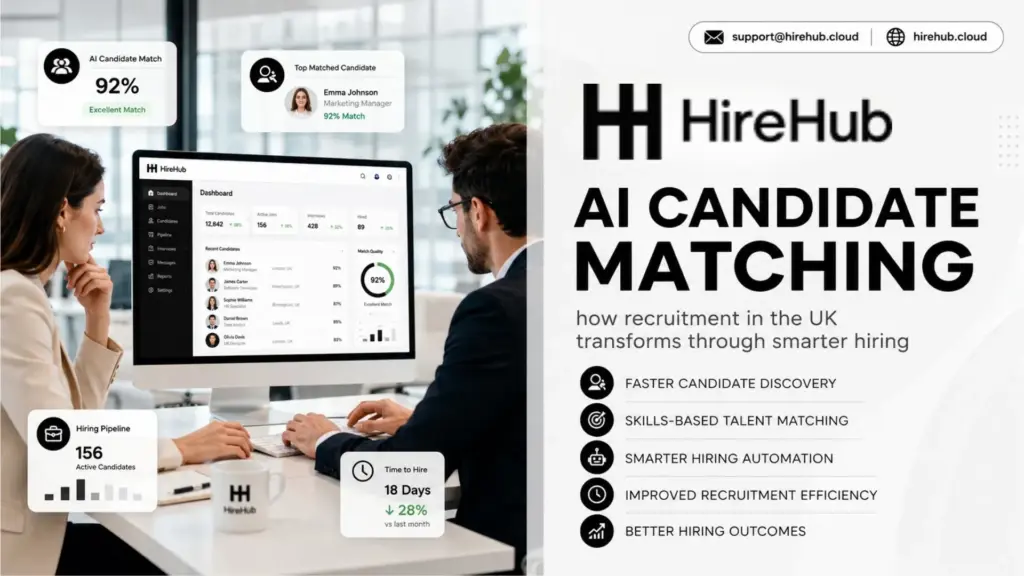
Artificial Intelligence (AI) Candidate Matching has emerged as a valuable recruitment solution. Instead of relying solely on keyword searches, modern AI technology evaluates skills, experience, career progression, and job requirements to identify candidates who align closely with available roles. This approach helps employers spend more time engaging with qualified candidates and less time reviewing unsuitable applications.
According to LinkedIn’s Future of Recruiting research, 73% of talent professionals believe AI will play an increasingly important role in shaping recruitment over the coming years. This growing adoption highlights the value businesses place on technology that supports better hiring outcomes.
Alongside AI Candidate Matching, Talent Matching tools, Recruitment Software in the UK, and Hiring Automation continue to support recruitment teams by streamlining hiring processes and improving candidate experiences. Together, these technologies help employers build stronger teams while creating more opportunities for job seekers.
This article explores how AI Candidate Matching supports modern recruitment, how Hiring Automation improves efficiency, and why many UK employers are embracing technology-driven talent acquisition strategies.
Why Recruitment Challenges Continue to Grow Across the UK:
Recruitment teams across the United Kingdom continue to adapt to changing workforce expectations, evolving skills requirements, and increasing competition for talent. Employers aim to attract candidates who can contribute value from day one while supporting long-term business growth. As hiring demands continue to increase, many organisations seek efficient ways to identify suitable candidates and create positive hiring experiences.
Rising Competition for Skilled Talent:
Many industries across the UK actively search for professionals with specialised skills and relevant experience. As businesses expand and digital transformation continues, demand for qualified candidates remains strong.
- Growing demand for specialist skills: Employers increasingly look for candidates who can contribute across technical, operational, and leadership roles.
- Expanding career opportunities: Professionals often explore roles that align with their goals, values, and development plans.
- Stronger focus on candidate experience: Organisations invest more effort into creating smooth and engaging recruitment journeys.
This environment encourages employers to adopt smarter recruitment strategies that help them connect with suitable talent more efficiently.
Longer Hiring Cycles Create Business Pressure:
Recruitment often involves multiple stages, including sourcing, screening, interviewing, and decision-making. Each stage contributes to the overall hiring timeline.
According to SmartRecruiters recruitment benchmark research, the median time-to-hire in the UK reaches approximately 40 days. This highlights the importance of efficient recruitment processes that help businesses secure talent while maintaining momentum.
- Multiple recruitment stages: Application reviews, interviews, and assessments contribute to overall timelines.
- Increasing application volumes: Recruiters frequently evaluate large numbers of applications for a single vacancy.
- Business growth objectives: Teams often benefit from filling positions promptly to support productivity and service delivery.
Efficient recruitment processes help organisations maintain progress while creating positive experiences for candidates.
Manual Screening Limits Recruitment Efficiency:
CV reviews remain an important part of recruitment. However, large applicant volumes can require significant time and attention from hiring teams.
- Time-intensive candidate reviews: Recruiters often review hundreds of applications for a single role.
- Valuable skills may require deeper analysis: Experience, transferable skills, and career progression frequently benefit from careful evaluation.
- Recruiter expertise delivers greater value elsewhere: Building relationships with candidates and conducting interviews often creates stronger hiring outcomes.
Modern recruitment technology helps teams process information more efficiently, allowing recruiters to focus on meaningful conversations, candidate engagement, and strategic hiring decisions.
Find Better Talent with Greater Confidence
What Does AI Candidate Matching Mean for Modern Recruitment?
Finding the right candidate often involves more than reviewing job titles and scanning CVs. Modern recruitment increasingly focuses on skills, experience, career growth, and future potential. AI Candidate Matching supports this approach by helping employers identify people whose capabilities align closely with role requirements.
Rather than relying on simple keyword searches, AI-powered systems analyse information in a more meaningful way. This allows recruiters to discover candidates who bring relevant strengths and valuable experience to the hiring process.
Semantic Analysis Improves Candidate Discovery:
Semantic analysis helps recruitment technology understand the meaning behind words and phrases rather than simply matching exact terms.
- Better understanding of experience: Similar responsibilities can appear in different ways across CVs, and semantic analysis helps identify these connections.
- Broader talent visibility: Recruiters gain access to candidates whose experience aligns with role requirements through related skills and achievements.
- Stronger candidate recommendations: Relevant candidates receive greater visibility during the screening process.
This approach creates more opportunities for employers to discover qualified professionals who may otherwise remain hidden within large applicant pools.
Skills Extraction Highlights Relevant Experience:
Skills extraction focuses on identifying the abilities, qualifications, and expertise that candidates bring to a role.
- Technical skills become easier to identify: Recruitment platforms can recognise specific capabilities and certifications across applications.
- Transferable strengths gain greater visibility: Valuable experience from different industries can support a wider range of opportunities.
- Career achievements receive greater attention: Recruiters gain clearer insight into professional accomplishments and practical experience.
This process supports informed hiring decisions while helping employers focus on candidates who align closely with business needs.
Candidate Ranking Supports Stronger Shortlists:
Candidate ranking helps recruiters organise applications based on relevance and suitability.
- Priority candidates appear more quickly: Recruiters can focus on applicants who closely match vacancy requirements.
- Consistent evaluation supports fairness: Applications receive structured assessment based on relevant criteria.
- Recruitment efficiency improves: Hiring teams can dedicate more time to interviews and candidate engagement.
A well-structured shortlist helps employers move forward with confidence and maintain momentum throughout the recruitment process.
Potential-Based Matching Broadens Talent Opportunities:
Modern recruitment increasingly values future potential alongside current experience. AI Candidate Matching supports this by recognising patterns of growth, learning, and career progression.
- Career development receives greater recognition: Candidates with strong growth trajectories gain visibility.
- Emerging talent becomes easier to identify: Employers can discover professionals who demonstrate readiness for future responsibilities.
- Long-term hiring success receives greater support: Recruitment decisions can align with both current requirements and future business goals.
Potential-based matching encourages organisations to build teams with a combination of experience, capability, and future promise, creating stronger foundations for continued growth.
How AI Candidate Matching Supports Better Hiring Outcomes?
Every employer hopes to find candidates who bring the right skills, experience, and enthusiasm to a role. As recruitment volumes continue to grow, hiring teams increasingly look for ways to make candidate selection more efficient and effective. AI Candidate Matching helps employers focus on quality, relevance, and long-term fit while supporting a smoother recruitment journey.
Faster Candidate Identification:
AI Candidate Matching helps employers quickly discover applicants whose skills and experience align closely with role requirements.
- Relevant candidates receive greater visibility: Matching technology highlights applicants whose qualifications support the position.
- Recruitment teams save valuable time: Recruiters can focus attention on high-potential candidates earlier in the process.
- Hiring progress moves forward efficiently: Faster identification supports quicker engagement with suitable talent.
This streamlined approach helps employers maintain a positive candidate experience while progressing vacancies more effectively.
Improved Candidate Quality:
Finding candidates who closely align with business requirements often leads to stronger hiring outcomes.
- Skills receive detailed evaluation: AI matching tools analyse abilities, qualifications, and professional experience.
- Experience aligns more closely with vacancy needs: Employers gain access to candidates whose backgrounds support the role.
- Potential receives greater consideration: Career progression and transferable strengths contribute to a broader assessment of suitability.
This focus on quality supports recruitment decisions that benefit both employers and candidates.
Greater Consistency Across Recruitment Processes:
Consistency helps create a fair and structured recruitment experience for every applicant.
- Evaluation criteria remain aligned: Applications are reviewed using the same standards and requirements.
- Recruitment decisions become more structured: Hiring teams gain clearer visibility into candidate suitability.
- Candidate comparisons become easier: Recruiters can assess applicants using consistent information and insights.
A consistent process helps organisations maintain confidence throughout every stage of recruitment.
Reduced Administrative Workload:
Recruitment professionals often balance sourcing, screening, communication, and interview coordination. AI Candidate Matching supports efficiency by simplifying several routine tasks.
- Candidate reviews become easier to manage: Recruiters can prioritise relevant applications more effectively.
- Information becomes easier to organise: Matching systems present key details in a clear format.
- More time becomes available for candidate engagement: Recruiters can focus on conversations, interviews, and relationship building.
This additional efficiency supports a more productive and rewarding recruitment process.
Enhanced Talent Acquisition Strategies:
Modern talent acquisition focuses on attracting individuals who can contribute both today and in the future.
- Talent pools become stronger: Employers gain access to a broader range of qualified candidates.
- Strategic hiring receives greater support: Recruitment decisions can align with business objectives and growth plans.
- Long-term workforce development becomes easier: Employers can identify individuals with valuable skills and future potential.
AI Candidate Matching helps organisations build stronger teams by combining data-driven insights with human expertise, creating hiring outcomes that support business success and candidate satisfaction.
How Hiring Automation Creates More Efficient Recruitment Workflows?
Recruitment teams often balance multiple responsibilities at the same time, from reviewing applications and scheduling interviews to communicating with candidates and coordinating hiring decisions. Hiring Automation helps simplify these tasks, allowing recruiters to dedicate more time to building relationships and identifying the right talent.
According to research from Employment Hero, organisations using recruitment automation can reduce manual CV screening time by up to 75%. This improvement helps recruitment teams process applications more efficiently while maintaining focus on candidate quality and engagement.
Automated CV Screening Accelerates Candidate Review:
Reviewing large numbers of applications can take significant time, particularly when vacancies attract strong interest. Automated screening helps recruiters organise and prioritise applications more effectively.
- Faster application assessment: Recruitment systems quickly identify candidates whose skills and experience align with vacancy requirements.
- Improved candidate visibility: Relevant applications receive greater attention during the initial review stage.
- Better use of recruiter expertise: Hiring professionals can focus on interviews, candidate engagement, and strategic hiring activities.
This approach helps organisations move suitable candidates forward more efficiently while maintaining a positive recruitment experience.
Automated Scheduling Improves Recruiter Productivity:
Interview scheduling often involves coordinating calendars, confirming availability, and managing communication between multiple parties. Automation helps simplify this process.
- Interview coordination becomes easier: Scheduling tools align availability between recruiters, hiring managers, and candidates.
- Faster communication supports engagement: Candidates receive timely updates and scheduling information.
- Recruitment timelines progress smoothly: Efficient scheduling helps maintain momentum throughout the hiring process.
With administrative tasks handled more efficiently, recruiters can invest additional time in meaningful conversations with candidates.
Recruitment Workflows Become Easier to Manage:
Structured workflows help recruitment teams maintain consistency and visibility across every hiring stage. Hiring Automation supports this by organising tasks and information in a centralised environment.
- Recruitment activities remain organised: Applications, interviews, and candidate communications are easier to track.
- Team collaboration improves: Hiring managers and recruiters can access relevant information throughout the process.
- Recruitment progress becomes clearer: Teams gain visibility into hiring stages and upcoming actions.
A well-managed workflow supports efficient recruitment operations while creating a smoother experience for employers and candidates alike. As hiring demands continue to evolve across the UK, automation helps recruitment teams combine speed, organisation, and quality to achieve stronger hiring outcomes.
Save Time and Focus on Great Talent
AI Candidate Matching Versus Traditional Recruitment Methods
Recruitment continues to evolve as businesses seek efficient ways to identify, engage, and hire talented professionals. Traditional recruitment methods have supported organisations for many years and continue to play an important role in hiring. At the same time, AI Candidate Matching introduces additional capabilities that help employers process information more efficiently and uncover suitable candidates with greater speed and accuracy.
Traditional Recruitment Relies Heavily on Manual Processes:
Traditional recruitment typically involves reviewing applications, comparing CVs, conducting candidate searches, and organising hiring activities through manual processes.
- Human expertise guides candidate selection: Recruiters use their experience and industry knowledge to evaluate applicants.
- Personal interactions support relationship building: Direct communication helps recruiters understand candidate goals and aspirations.
- Recruitment decisions benefit from professional judgement: Hiring teams assess experience, qualifications, and cultural alignment throughout the process.
Traditional recruitment creates valuable opportunities for candidate engagement and relationship development. As application volumes continue to increase, many organisations also seek additional tools that support efficiency and consistency.
AI-Powered Matching Strengthens Recruitment Decisions:
AI Candidate Matching complements recruiter expertise by helping teams analyse candidate information more efficiently and identify relevant talent quickly.
- Candidate recommendations become more targeted: AI evaluates skills, experience, qualifications, and career progression to support matching accuracy.
- Recruitment efficiency improves: Hiring teams can prioritise suitable candidates earlier in the recruitment process.
- Broader talent opportunities emerge: Matching technology helps uncover candidates whose skills align closely with role requirements.
- Consistent evaluation supports hiring quality: Applications receive structured assessment based on relevant recruitment criteria.
This combination of technology and human expertise creates a balanced recruitment approach that supports both efficiency and candidate experience.
Comparison Between Traditional Recruitment and AI Candidate Matching

Both approaches contribute value to modern recruitment. Many organisations achieve the strongest results by combining recruiter expertise with AI-powered candidate matching, creating a hiring process that supports efficiency, quality, and positive candidate experiences.
Which Recruitment Software Features Deliver the Greatest Value?
Choosing recruitment software involves more than selecting a platform with the longest feature list. The greatest value often comes from tools that help employers attract suitable candidates, improve hiring efficiency, and make informed recruitment decisions. Modern recruitment software combines AI-powered technology, automation, and workforce insights to support every stage of the hiring journey.
Intelligent Candidate Matching Capabilities:
Intelligent matching technology helps employers identify candidates whose skills and experience align closely with job requirements.
- Skills-based recommendations: Recruitment platforms analyse qualifications, experience, and competencies to highlight suitable applicants.
- Faster candidate discovery: Recruiters can quickly focus on candidates who closely match vacancy requirements.
- Improved hiring quality: Strong alignment between candidates and roles supports better recruitment outcomes.
Platforms such as Bullhorn, HireXR, and VacancV have introduced AI-powered matching features that help recruitment teams evaluate talent more efficiently.
Recruitment Automation Functionality:
Automation helps simplify routine recruitment activities and allows hiring teams to focus on candidate engagement and decision-making.
- Automated application screening: Applications can be organised and prioritised based on relevant criteria.
- Interview scheduling support: Coordination between candidates and hiring teams becomes easier to manage.
- Streamlined communication: Recruitment workflows benefit from timely updates and organised processes.
Solutions such as Employment Hero and SmartRecruiters include automation tools that support efficient recruitment management.
Talent Pipeline Management Tools:
Building strong talent pipelines helps organisations maintain access to qualified candidates for future opportunities.
- Candidate relationship management: Recruitment teams can engage with talent over longer periods.
- Talent pool organisation: Candidate information remains accessible and easy to manage.
- Future hiring readiness: Employers can connect with suitable professionals when new vacancies arise.
Effective pipeline management helps businesses strengthen workforce planning while supporting long-term recruitment goals.
Reporting and Recruitment Analytics:
Data-driven insights help employers understand recruitment performance and identify opportunities for improvement.
- Hiring metrics visibility: Recruitment teams can track key performance indicators and hiring activity.
- Recruitment process evaluation: Organisations gain insight into candidate attraction and engagement efforts.
- Better decision-making support: Data helps employers refine recruitment strategies and improve efficiency.
Analytics tools transform recruitment information into practical insights, helping businesses make informed hiring decisions while supporting continuous improvement across the recruitment process.
The most effective recruitment software combines intelligent matching, automation, talent management, and reporting capabilities. Together, these features help employers build stronger teams, improve hiring efficiency, and create positive experiences for candidates throughout the recruitment journey.
How HireHub Helps Employers Connect with Better Talent?
Finding the right candidate often requires a balance of speed, quality, and efficiency. Many employers seek recruitment solutions that simplify hiring while helping them connect with professionals who align with their business goals. HireHub brings together AI-powered technology, candidate verification, recruitment tools, and flexible hiring solutions to support smarter talent acquisition across the United Kingdom.
As businesses increasingly adopt AI-driven recruitment technology, platforms that combine intelligent matching and streamlined workflows continue to play an important role in helping employers attract and engage qualified talent.
AI-Powered Candidate Matching Streamlines Hiring:
HireHub uses advanced candidate matching technology to help employers discover relevant talent more efficiently.
- Skills-focused matching: Candidate profiles are matched with vacancy requirements based on skills, experience, and qualifications.
- Faster talent discovery: Employers can identify suitable candidates without spending extensive time reviewing large application volumes.
- Improved hiring efficiency: Recruiters can focus on engaging with candidates who align closely with role requirements.
This approach supports a more efficient recruitment process while helping businesses build stronger teams.
Verification Tools Support Trusted Recruitment:
Trust and transparency contribute significantly to successful hiring decisions. HireHub supports this through candidate verification features that help employers gain greater confidence throughout the recruitment journey.
- Verified candidate profiles: Employers can access additional indicators that support profile authenticity.
- Greater recruitment confidence: Verification tools help create a more transparent hiring environment.
- Stronger candidate credibility: Verified information helps employers evaluate applicants with greater clarity.
These features contribute to a trusted recruitment experience for both employers and job seekers.
Recruitment Workflows Become Easier to Manage:
Managing vacancies, applications, and candidate communications becomes more straightforward when recruitment activities are organised in a single platform.
- Centralised recruitment management: Employers can oversee recruitment activities from one location.
- Streamlined candidate tracking: Applications and hiring progress remain easy to monitor.
- Improved collaboration: Recruitment teams and hiring managers can work together more efficiently.
This structured approach supports smoother recruitment operations and improved productivity.
Flexible Hiring Solutions Support Growing Businesses:
Businesses often require recruitment solutions that adapt to changing workforce needs. HireHub supports organisations through flexible hiring options designed for modern recruitment demands.
- Permanent recruitment support: Employers can connect with candidates for long-term positions.
- Temporary workforce solutions: Flexible hiring options help businesses manage changing staffing requirements.
- Scalable recruitment capabilities: Recruitment tools can support organisations as hiring activity grows.
By combining AI-powered matching, candidate verification, streamlined workflows, and flexible hiring solutions, HireHub helps employers connect with quality talent while creating a more efficient and engaging recruitment experience.
What Compliance Considerations Matter When Using AI Recruitment Technology?
AI recruitment technology continues to support employers across the UK with candidate matching, screening, and hiring efficiency. Alongside these advantages, responsible use of technology plays an important role in creating fair, transparent, and trustworthy recruitment experiences. Employers who combine innovation with clear compliance practices can build stronger relationships with candidates while supporting high recruitment standards.
GDPR Requirements Guide Responsible Recruitment:
The General Data Protection Regulation (GDPR) provides a framework that helps organisations handle candidate information responsibly and professionally.
- Candidate information receives appropriate protection: Personal data is managed with care throughout the recruitment process.
- Clear data management practices support confidence: Candidates benefit from understanding how information contributes to recruitment decisions.
- Responsible recruitment standards strengthen credibility: Employers demonstrate their commitment to professional hiring practices.
Following GDPR principles helps create a recruitment experience that values privacy, trust, and accountability.
Human Oversight Remains an Essential Part of Hiring:
AI technology supports recruitment teams by providing insights and recommendations, while people continue to play a central role in decision-making.
- Recruiter expertise adds valuable context: Hiring professionals consider experience, communication skills, and role suitability during candidate evaluation.
- Balanced decision-making supports quality outcomes: Technology and human judgement work together throughout the recruitment journey.
- Candidate engagement remains people-focused: Conversations, interviews, and relationship building continue to shape successful hiring experiences.
This combination of technology and professional expertise helps organisations make informed recruitment decisions while maintaining a human-centred approach.
Transparency Strengthens Candidate Trust:
Transparency encourages confidence and helps candidates understand how recruitment processes operate.
- Clear communication supports positive experiences: Candidates appreciate understanding how applications progress through hiring stages.
- Open recruitment practices encourage engagement: Transparency helps create stronger connections between employers and job seekers.
- Responsible AI usage supports credibility: Employers who explain how technology contributes to recruitment decisions build greater confidence among applicants.
When transparency, human oversight, and data protection work together, organisations create a recruitment environment that supports trust, fairness, and long-term hiring success.
What Trends Shape the Future of Recruitment in the UK?
Recruitment across the United Kingdom continues to evolve as employers seek smarter ways to attract, assess, and engage talent. Advances in AI, workforce data, and recruitment technology are helping businesses make informed hiring decisions while creating better experiences for candidates. Organisations that embrace these developments often gain greater flexibility, efficiency, and access to skilled professionals.
Skills-First Hiring Continues to Gain Momentum:
Employers increasingly focus on skills, capabilities, and potential when evaluating candidates. This approach helps organisations discover talent from a wider range of backgrounds and experiences.
- Practical abilities receive greater attention: Employers can identify candidates whose skills align closely with role requirements.
- Career opportunities become more accessible: Professionals can showcase capabilities gained through different experiences and career paths.
- Workforce flexibility increases: Skills-focused hiring supports stronger alignment between talent and business needs.
Talent Intelligence Supports Workforce Planning:
Workforce planning benefits from deeper insight into skills availability, hiring trends, and candidate behaviour. Talent intelligence helps employers make informed decisions about future recruitment needs.
- Recruitment strategies become more targeted: Organisations gain visibility into emerging talent opportunities.
- Workforce planning supports business growth: Employers can align hiring activities with future objectives.
- Candidate insights improve decision-making: Recruitment teams gain a clearer understanding of talent availability and demand.
These insights help businesses prepare for future workforce requirements while maintaining agility in changing market conditions.
Recruitment Technology Drives Strategic Hiring:
Modern recruitment software continues to play an increasingly important role in helping organisations attract and manage talent efficiently.
- Recruitment processes become more streamlined: Technology supports application management, communication, and candidate engagement.
- Hiring decisions benefit from data-driven insights: Employers gain access to valuable recruitment information throughout the hiring journey.
- Team collaboration improves: Recruiters and hiring managers can work together through integrated platforms.
As recruitment technology continues to advance, employers gain additional tools that support both operational efficiency and strategic workforce planning.
AI-Powered Talent Matching Continues to Evolve:
AI-driven talent matching continues to enhance the way employers connect with candidates. Matching technology increasingly evaluates skills, experience, qualifications, and career progression to support stronger hiring outcomes.
- Candidate recommendations become more relevant: AI helps identify talent aligned with vacancy requirements.
- Recruitment efficiency continues to improve: Hiring teams can focus attention on candidates with strong potential.
- Long-term workforce development gains support: Employers can discover professionals who contribute value both today and in the future.
As AI technology continues to advance, talent matching will play an increasingly important role in helping UK employers build stronger teams while creating meaningful opportunities for job seekers.
Frequently Asked Questions
Are AI jobs in strong demand across the UK?
AI-related roles continue to attract significant interest across the United Kingdom. Businesses in sectors such as technology, healthcare, finance, retail, manufacturing, and professional services increasingly invest in artificial intelligence to improve efficiency and support innovation. As a result, demand for professionals with AI, data analysis, machine learning, and automation skills continues to grow. This trend also creates opportunities for individuals who combine technical expertise with business, communication, and problem-solving capabilities.
Can AI support candidate shortlisting?
AI can support candidate shortlisting by analysing CVs, qualifications, skills, experience, and job requirements to identify applicants who closely align with a vacancy. Modern AI Candidate Matching technology helps recruitment teams review applications more efficiently and prioritise suitable candidates for further evaluation. This approach supports faster hiring workflows while allowing recruiters to focus on interviews, candidate engagement, and final hiring decisions.
How does AI contribute to modern interview processes?
AI contributes to interview processes by helping recruiters prepare candidate assessments, organise interview schedules, and analyse information gathered during the recruitment journey. Some platforms also provide structured interview guidance and candidate insights that support consistent evaluations. These tools help recruitment teams make informed decisions while maintaining meaningful interactions with candidates throughout the hiring process.
Which capabilities do AI recruitment platforms provide?
AI recruitment platforms offer a range of capabilities designed to improve recruitment efficiency and candidate quality. Common features include AI Candidate Matching, talent matching, CV screening, candidate ranking, hiring automation, interview scheduling, recruitment analytics, and workforce planning insights. Many platforms also provide applicant tracking, candidate communication tools, and reporting dashboards that help employers manage recruitment activities more effectively.
Does hiring automation reduce recruitment effort?
Hiring automation helps streamline many routine recruitment activities, including application screening, interview coordination, candidate communication, and workflow management. By automating repetitive administrative tasks, recruitment teams can dedicate more time to strategic hiring activities and candidate engagement. This balanced approach helps organisations improve productivity while maintaining a positive recruitment experience for both employers and job seekers.
Why do recruiters continue to play an important role alongside AI?
Recruiters bring valuable expertise, judgement, communication skills, and relationship-building capabilities to the hiring process. While AI provides insights, recommendations, and efficiency gains, people continue to guide interviews, evaluate cultural alignment, assess career goals, and make final hiring decisions. The combination of recruiter expertise and AI-powered technology creates a recruitment process that supports efficiency, consistency, and strong hiring outcomes.
Conclusion
Recruitment across the United Kingdom continues to evolve as employers seek efficient ways to attract skilled professionals and build strong teams. Growing application volumes, increasing demand for specialised skills, and longer hiring timelines encourage organisations to explore smarter recruitment strategies. Technology now plays an important role in helping businesses manage hiring activities while creating positive experiences for candidates.
AI Candidate Matching, Talent Matching, Recruitment Software, and Hiring Automation support this transformation by helping employers identify relevant candidates more efficiently and make informed hiring decisions. These technologies simplify recruitment workflows, improve candidate discovery, support skills-based hiring, and allow recruiters to focus on meaningful engagement throughout the hiring journey. Combined with human expertise, they contribute to stronger hiring outcomes and more effective talent acquisition strategies.
As organisations continue to embrace innovation, AI-powered recruitment technology will support more personalised, efficient, and data-informed hiring processes. Employers who combine technology with people-focused recruitment practices will be well positioned to connect with talented professionals and support future workforce growth across the UK.